

Sîmir Rûdan behsa albûma "ez ê gîtara xwe" dike
Di vê bernameya taybet a Botan Timesê de, hunermend û muzîkjenê navdar Sîmir Rûdan mêvanê weşana me ya zindî ye.
Di vê bernameya taybet a Botan Timesê de, hunermend û muzîkjenê navdar Sîmir Rûdan mêvanê weşana me ya zindî ye.

In this special Botan Times episode, we take an in-depth look at the mission, history, and work of the
Di vê bernameya taybet a Botan Timesê de, em li ser dîrokçe, armanc û xebatên berfireh ên Navenda Kurdistanê ya

DIYARBAKIR — Speaking to Botan Times, Dr. Cuma Çiçek pointed out that for the past 20 years, whenever the Kurdish issue is discussed, the debate focuses entirely on violence and identity. However, Çiçek underlines that Kurds face much heavier problems today.
 Murat Bayram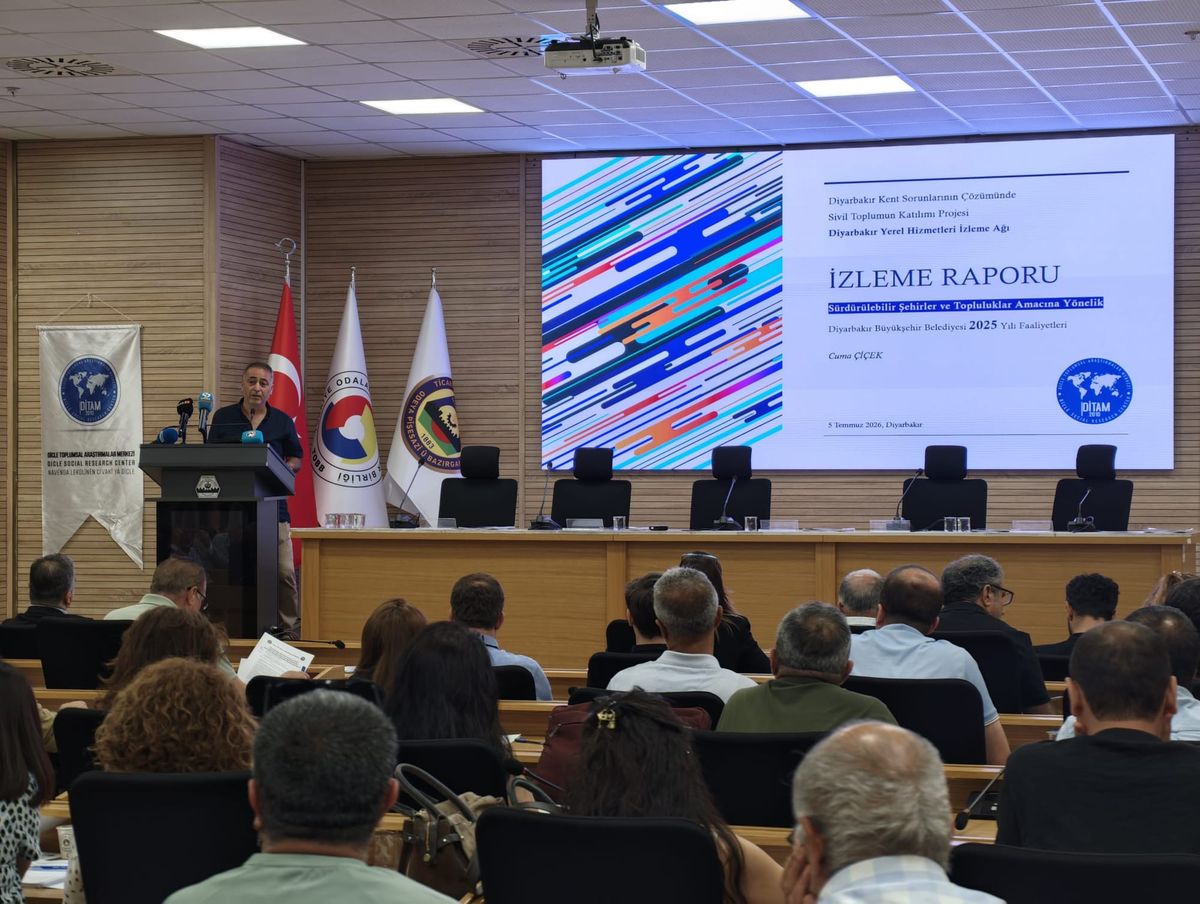
"Especially after the PKK (Kurdistan Workers' Party) lays down its arms, these debates will expand," Çiçek said.
"Kurds face daily life struggles, economic hardships, transportation issues, and the homelessness of the poor. Of course, these are inevitably linked to identity, but we must discuss them one by one and look for real solutions. This is why we prepared a report on municipal services, based on the 17 sustainable development goals for society and cities."
Organized by DITAM (Dicle Center for Social Research), Cuma Çiçek presented the "Monitoring Report - For Sustainable Cities and Societies" yesterday on July 5.
The meeting brought together civil society representatives and municipal officials, including Diyarbakır Metropolitan Municipality Co-Mayor Serra Bucak and various municipal executives.
In her speech, Bucak stated that when they took office after eight years of state-appointed trustees (kayyum), most institutions and projects had been ruined, making it difficult to carry out their plans.
"The easiest part is releasing political manifestos, but executing them is hard," the Co-Mayor said. "We will use all your suggestions and criticisms as a strong guide for our 2027 strategic plan."
Çiçek announced that their report will be published online for the public very soon. Sharing key findings, he noted that while the municipality's bus fleet increased by 20% in a year, wastewater treatment meets the city's capacity, and rural water supply is at a decent standard, parks and green spaces remain severely lacking. Furthermore, the urban poor lack housing, and construction services for public shelters are in poor condition.
Speaking at the Chamber of Commerce and Industry, Çiçek described Diyarbakır as a shared city. He noted that dozens of civil society organizations gathered in the scorching Diyarbakır summer heat to monitor municipal services, showing how much people want to work for their city. He added that this is a great opportunity, as the municipality shows it can handle and accept criticism.
Throughout his speech, Çiçek focused on "sustainable cities," emphasizing that everything is interconnected:
"Urban cultural services are at a good level. But to go to a theater, for instance, you first need a comfortable and easy transportation system (buses, minibuses...) for everyone. And this shouldn't just be for the city center. In Turkey, since 2014, all villages and rural districts have been linked to metropolitan municipalities, yet municipalities still act as if they are only responsible for the city center. Sadly, out of 973 districts in Turkey, 10 of Diyarbakır's districts are among the 100 most underdeveloped. Services must be distributed fairly across the entire city, not just the center."
Çiçek pointed out that he compiled this report using official municipal data. He mentioned that while the municipality set great goals for certain services, it failed to execute many of them. Citing the "Zero Waste" project, he explained that the municipality provides no services for waste segregation or recycling.
"The goal is to separate all waste for energy and recycling, but no steps have been taken," Çiçek said.
"The current system is simple: district municipalities collect the trash from the neighborhoods, and the metropolitan municipality just takes it and dumps it."
Who is Cuma Çiçek?
Dr. Cuma Çiçek completed his PhD in Political Sociology and Public Policy at the Paris Institute of Political Studies (Sciences Po). He later held various positions at Mardin Artuklu University and Sciences Po. He currently continues his academic research at the French Institute of Anatolian Studies (IFEA).
Early Life and Education Cuma Çiçek was born in Diyarbakır in 1980, where he completed his primary, secondary, and high school education. In 2004, he graduated from Istanbul Technical University (ITU) with a degree in Industrial Engineering. He completed his Master’s degree in Urban and Regional Planning at the same university in 2008.
Municipal Work and Local Activities Between 2006 and 2008, Çiçek worked inside the Diyarbakır Metropolitan Municipality. During this time, he served as a project expert, strategic planning and management coordinator, and advisor.
Research Fields and Academic Articles His articles have been published in journals such as Birikim, Praksis, Turkish Studies, and Dialectical Anthropology. His research mostly focuses on the Kurdish issue, Kurdish Islamist movements, and local governance. He also studies regional inequality, class-identity dynamics, conflict resolution, and multi-party peacebuilding.
Recent Books Çiçek has written major books on the political future of the region. His latest book on power-sharing and decentralization was published by the Memory Center (Hafıza Merkezi) in 2021. His previous books, focusing on Kurdish identities and conflict resolution paths, came out in 2017 and 2018.
External sources: DITAM Report, bianet biography archives.
Translations on Botan Times are assisted by Gemini AI. All content is thoroughly reviewed and approved by an editor before publication.

In this special Botan Times episode, we take an in-depth look at the mission, history, and work of the

In this comprehensive and inspiring interview on Botan Times, we sit down with internationally acclaimed researcher and academic Dr. Pawan

In this in-depth interview on Botan Times, renowned Dutch philosopher and linguist Dr. Michiel Leezenberg (University of Amsterdam) discusses

DIYARBAKIR — The Avesta Cultural Foundation has announced that its inaugural Honor Award will be presented to the distinguished historian and

Tu eposteya xwe binivîsî em ê ji te re bûltenan belaşî bişînin...