


After bone marrow cancer struck my dear brother Lezgîn, he spent exactly a year and three months in a hospital in Germany. For a long time, I only received updates through his family. Later, I began sending him short audio messages, asking how he was faring. He would reply in a faint, weary voice, offering just a few words about his condition.
 Murat Bayram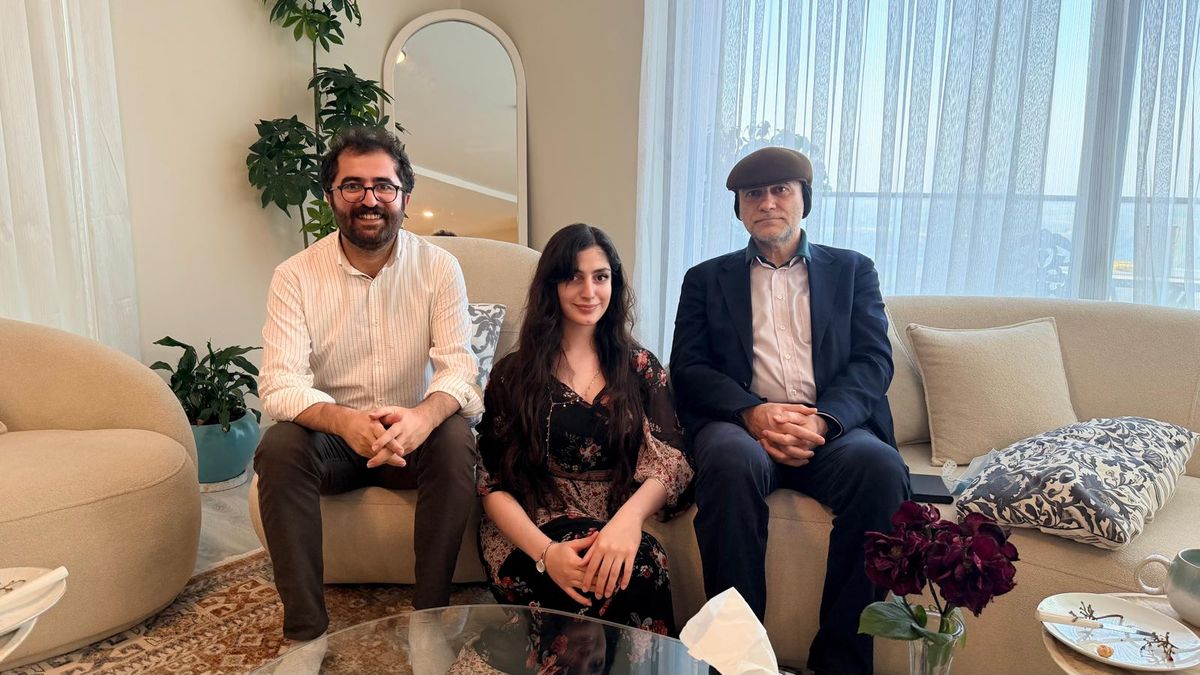
I couldn't bear to be without news of him. Yet every time we spoke, it felt as though a dagger pierced my heart, adding another heavy stone to the burden weighing on my back.
Last week, my phone rang with a voice of good tidings. When I answered, Lezgîn spoke immediately, his voice remarkably free, clear, and vibrant.
“Elo! Keko, how are you?”
When he uttered those most ordinary, everyday words, I was standing up. I slowly sank into a chair. I paused for two or three seconds. My face flushed warm. For a moment, I lost my words. Before I could answer him, I blurted out with an intense rush of mixed emotions:
“Your voice sounds good. Are you well?”
“Yes, keko, I'm well, I've come home. When are you coming?”
I stood frozen in my tracks and found myself repeating:
“Your voice sounds so beautiful! You are well? Truly?”
“Yes, keko, Alhamdulillah. So, when are you coming?”
“Your voice… it's clear from your voice that you are well!”
“Alhamdulillah!”
“I will come this week.”
“You are more than welcome...”
It evokes a scene from my childhood: an old, stooped Sufi sitting in the corner of the Gundikê Melî mosque, rhythmically clicking his prayer beads one after another in perfect order, whispering blessings upon the Prophet. Sometimes, I too can line up words like those prayer beads, racing the horse of conversation to the rhythm of those recitations. But this time, my prayer beads had snapped, and the beads of my words were scattered everywhere.
I hung up the phone immediately.
A wave of tears overcame me. God has often blessed me with good news out of His mercy and grace, but for the first time in my entire life, tears of joy streamed down my face upon hearing a piece of good news. Perhaps it was because for a very long time, my heart and soul had been bruised by the weight of his illness. I had been unaware of his recovery process, and suddenly he had called out to me with that voice and that energy. It left me overwhelmed by a profound emotional void...
After all, just a few days before his brother's bone marrow was to be transplanted to him, he had told me over the phone, “If everything goes well...”
That “if” was heavier than a mountain... I never wanted to contemplate a painful outcome.
Like anyone who believes in a cause, I had to swallow the lump in my throat. I needed to return to my Kurdish work. Yet it was impossible to write anything in Kurdish without one of Lezgîn's commentaries coming to mind, causing that swallowed lump to nest itself in my throat once again.
After our conversation (and my tears), I wrote to him on WhatsApp:
“How much your recovered voice has healed my soul as well. At that exact moment, it felt like reaching your warm and safe home out of a heavy downpour and storm… I hadn't realized what a heavy burden it was to wait for good news. Praise be to God.”
My First Friend from the South
Seventeen years ago, I met Lezgînê Çalî for the first time. I used to read his articles, and I was immensely fond of his writings published on Nefel. I had even printed and bound his articles as a gift for my colleagues at Kurd1 (Hatice Kamer and Meral Aydogan). I considered that collection of writings a precious gift and gave copies to a few other people as well.
To visit my uncle Evdirehman (Gundikî), I was planning to travel to the South (Iraqi Kurdistan). I was 19 or 20 years old, a fresh university student. My focus was entirely on folklore collection, grammar, stories, and journalism. During my trip to the South, I wanted to meet a writer and a journalist. From the North (Southeastern Turkey), I had two friends: Mistefa Aydogan and Arjen Arî.
I didn't know Lezgîn was a doctor. To me, he was a writer, and he was the author I most wanted to meet. I only knew Uncle Samî (Ergoşî). He was both the representative of Kurd1, and back when he was at Kurdistan TV, our family used to watch his program called Ronî. He was a friend of my uncle; when I arrived in the South, he looked after me with the kindness of a relative.
I wanted to meet a journalist with whom I could debate journalism and learn from. I asked my uncle Mihemed (Sanri). He said if there was only one person I should meet, it had to be Ako (Mihemed), the editor of Rûdaw Magazine. He sent his number, but Ako Mihemed said he wasn't in Erbil. For me, only one name remained: Lezgînê Çalî.
I wrote him an email. While I was still sitting at the computer, he replied instantly:
“I am at the clinic. My work finishes in half an hour. Where are you?”
I sent him my uncle's phone number. Immediately after his shift, he arrived. He drove a red Jeep and wore a jacket that was slightly too large for him. In our very first meeting, he embraced me. Then he said, “Let's go to our house, we will have dinner at our place.”
The sweetest girl in the South, Zîlan, was to be born just a few days later, which was why her mother was unwell. The walls of the house were white. There was a long living room. The son of the house (Yehya) was ten years younger than me, while the father was twenty years older. I quickly became friends with both. Since I was shy and reserved, and the daughters of the house were much the same, within a few years, I would become close friends with them too.
In my diary, I noted two words they used frequently: “selam” (hello) and “memnûn” (pleased/grateful)... These were the words we said to each other most. Lezgîn even convinced my uncle and wouldn't let me leave his house. I was too shy to say either yes or no.
When Zîlan grew a little older, she became my playtime companion. She was so uninhibited and free-spirited, and she helped me become free-spirited too.
Zîlan and I
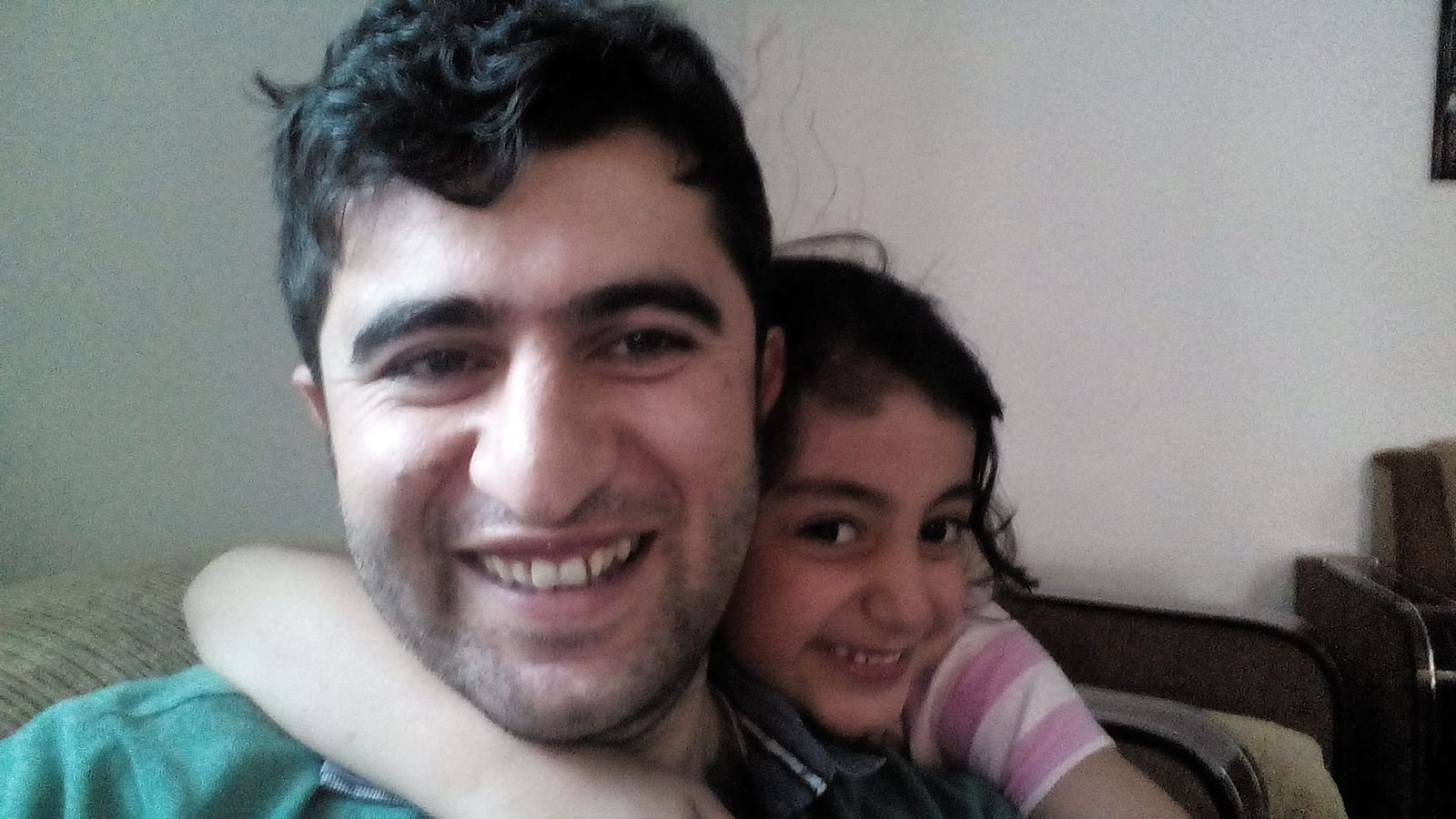
Today, I do not need to say, “We have been a family friend for a lifetime.” That measure is clear: We have been a family friend for as long as Zîlan's lifetime. I ought to write two or three pieces about Zîlan, but that is not today's focus.
Since that time, whenever I visited the South, I stayed at that house. I also happened to make another friend during my very first trip—Uncle Diyar (Mizûrî). On every subsequent trip, I would visit him too...
Should I Come Get You?
Wherever Lezgîn went, I would go to see him: Istanbul, Diyarbakır, Mardin, Kızıltepe (Kosar), Hakkari (Colemêrg)... Sometimes he would say, “Why haven't you come? The children miss you,” and I would go.
In 2015, much like in 2024 and 2025, I broke down across multiple fronts of life: work, family, finances... I had worked every single day of the year, and then I said, enough is enough. When I decided to stop working for television, I would sleep 10 to 15 hours a day. Lezgîn called me exactly during a time when my heart was heavy with grief.
“Keko, what are you doing?”
“I don't know, I'm just sleeping. My exhaustion won't go away.”
“How do you feel?”
“I am lost. I can't walk the old path, but I haven't found a new one either.”
“How! Are you lost?”
“Everything, including myself, feels alien to me. I have no strength left to do anything.”
“Keko, come to our house!”
“No, I can't move from where I am.”
“Keko, are you coming, or should I come and get you?”
“Alright, I'm coming.”
Even when I went, I didn't tell him my troubles. My friend and colleague Muriel came with me at Lezgîn’s invitation. We went touring, and I didn't speak at all. He played Xoşnav Têlo's song, Winda (Lost), for me. I said, “This is me, don't change the song.” I could listen to the same song fifty times, but it was torture for him.
While we were walking through the bazaar, he grabbed my arm and said: “As long as the light of the heart does not go out, there is always hope.”
And indeed, after returning from his home, I resolved to write news in English, even though my English was not yet sufficient. By the second week, I started writing news for Middle East Eye. I asked Neşet Girasun and Tahir Elçî for permission to use their office as a studio for an hour. There, I recorded a test broadcast for Al Jazeera International, and my work was accepted… Later came Deutsche Welle (DW), The New York Times, BBC… The light of my heart had not gone out, and hope had shown me its merciful face.
I will stop talking now; just look at this picture of happiness. God delivered our dear Lezgîn from his illness, my dearest friend Zîlan has beautifully grown up, and as for me...
Translations on Botan Times are assisted by Gemini AI. All content is thoroughly reviewed and approved by an editor before publication.

Zêdetir bixwîne

Botan International Honored with 40th Anniversary Press Freedom Award; Dedicates Prize to Reporters Without Borders (RSF)
The Southeastern Journalists Association (GGC)—a 49-year-old organization with nearly 400 members—has been honoring journalism through its

Early puberty prevents children from reaching full height — Zelal Sinayiç
Early puberty in children can restrict overall growth and trigger lasting psychological distress, according to Şervan Özalkak, a pediatric endocrinologist


B. R. Amed, Entered Prison at 23 and Walked Free at 53: 'I Realized I Had to Save Myself First, Not the World'"
Author and journalist Bejdar Ro Amed, who stepped into freedom at age 53 after entering prison at 23, spoke about

Serdar Şengul, Ferzan Şêr: How Can We Build a Kurdish Public Sphere?
In this article, we spoke with Serdar Şengul and Ferzan Şêr, the hosts and creators of BaneşanPodcast. In this text,
